
Request Your Free Research Report Now:
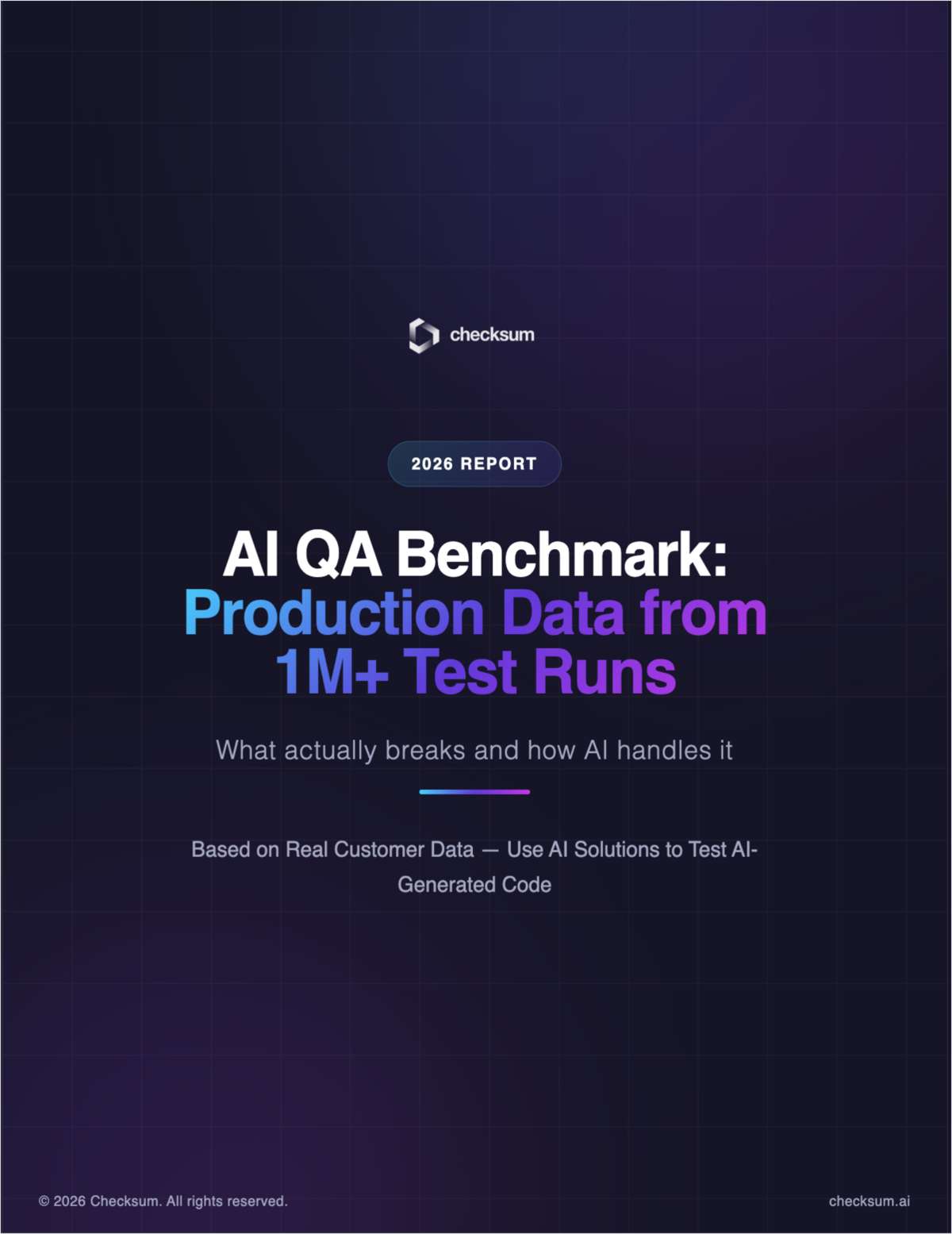
"AI QA Benchmark: Production Data from 1M+ Test Runs"
Analysis of over one million production test runs reveals what actually causes web automation to fail and how AI-assisted maintenance changes the economics of test suite reliability. This benchmark examines failure patterns across hundreds of applications, comparing human-only versus AI-assisted repair times, success rates by root cause, and total cost of ownership for test maintenance at scale.
Web agent benchmarks suggest AI is not ready for production automation, reporting low success rates and implying that agent-driven workflows are unreliable. Yet real companies are already using AI to maintain test automation at scale. This contradiction exists because benchmarks measure model behavior in isolation, while production automation depends on resilience over time.
This paper presents empirical data from over one million production test runs across hundreds of web applications, analyzing what causes automation to fail, how often, and what it costs engineering teams.
What Actually Breaks
Test automation fails in predictable ways. Selector changes account for 32% of failures, flow changes 27%, environment instability 22%, and loading or timing issues 19%. Most failures occur in layers AI can understand and repair—selectors, DOM structure, and flow logic.
The Cost of Manual Maintenance
For a team with 500 tests, median failure rates produce 1,850 failures monthly. At 1.3 hours per failure (including investigation, fix, verification, and review), this equals over one full-time engineer annually. Investigation dominates this time, consuming 41% of effort. Engineers spend more time figuring out what broke than fixing it.
AI-Assisted Maintenance
AI operates in two stages: real-time recovery during execution and auto-healing that updates test code between runs. From production data, 70% of failures resolve fully autonomously, 28% need quick human review (under 10 minutes), and 2% require manual intervention. Weighted average time per failure drops to 5 minutes—a 94% reduction.
Monthly maintenance costs drop from $360,750 to $4,200 for a 500 suite—a 99% reduction. AI-maintained suites also show 82% lower baseline failure rates: 2.7 per 100 runs versus 14.8 for manual maintenance.
Why Current Benchmarks Miss This
Standard benchmarks test one-shot task completion on diverse websites. Production automation is different: workflows are recurring, UI changes are constant, and reliability is measured over months, not single attempts. AI doesn't need to navigate arbitrary sites from scratch—it needs to maintain workflows teams defined, adapting as sites evolve.
Offered Free by: Checksum.ai
See All Resources from: Checksum.ai
Recommended for Professionals Like You:
Thank you
This download should complete shortly. If the resource doesn't automatically download, please, click here.