Close
- Information Technology
- Data Infrastructure
- Data Tools
- Desktops, Laptops and OS
- Chip Sets
- Collaboration Tools
- Desktop Systems - PCs
- Email Client
- Embedded Systems
- Hardware and Periferals
- Laptops
- Linux - Open Source
- Mac OS
- Memory Components
- Mobile Devices
- Presentation Software
- Processors
- Spreadsheets
- Thin Clients
- Upgrades and Migration
- Windows 7
- Windows Vista
- Windows XP
- Word Processing
- Workstations
- Enterprise Applications
- IT Infrastructure
- IT Management
- Networking and Communications
- Bluetooth
- DSL
- GPS
- GSM
- Industry Standard Protocols
- LAN - WAN
- Management
- Mobile - Wireless Communications
- Network
- Network Administration
- Network Design
- Network Disaster Recovery
- Network Interface Cards
- Network Operating Systems
- PBX
- RFID
- Scalability
- TCP - IP
- Telecom Hardware
- Telecom Regulation
- Telecom Services
- Telephony Architecture
- Unified Communications
- VPNs
- VoIP - IP Telephony
- Voice Mail
- WAP
- Wi-Fi (802.11)
- WiMAX (802.16)
- Wide Area Networks (WAN)
- Wireless Internet
- Wireless LAN
- Security
- Servers and Server OS
- Software and Web Development
- .Net Framework
- ASPs
- Application Development
- Application Servers
- Collaboration
- Component-Based
- Content Management
- E-Commerce - E-Business
- Enterprise Applications
- HTML
- IM
- IP Technologies
- Integration
- Internet
- Intranet
- J2EE
- Java
- Middleware
- Open Source
- Programming Languages
- Quality Assurance
- SAAS
- Service-Oriented Architecture (SOA)
- Software Engineering
- Software and Development
- Web Design
- Web Design and Development
- Web Development and Technology
- XML
- Storage
- Agriculture
- Automotive
- Career
- Construction
- Education
- Engineering
- Broadcast Engineering
- Chemical
- Civil and Environmental
- Control Engineering
- Design Engineering
- Electrical Engineering
- GIS
- General Engineering
- Industrial Engineering
- Manufacturing Engineering
- Materials Science
- Mechanical Engineering
- Medical Devices
- Photonics
- Power Engineering
- Process Engineering
- Test and Measurement
- Finance
- Food and Beverage
- Government
- Healthcare and Medical
- Human Resources
- Information Technology
- Data Infrastructure
- Data Tools
- Desktops, Laptops and OS
- Chip Sets
- Collaboration Tools
- Desktop Systems - PCs
- Email Client
- Embedded Systems
- Hardware and Periferals
- Laptops
- Linux - Open Source
- Mac OS
- Memory Components
- Mobile Devices
- Presentation Software
- Processors
- Spreadsheets
- Thin Clients
- Upgrades and Migration
- Windows 7
- Windows Vista
- Windows XP
- Word Processing
- Workstations
- Enterprise Applications
- IT Infrastructure
- IT Management
- Networking and Communications
- Bluetooth
- DSL
- GPS
- GSM
- Industry Standard Protocols
- LAN - WAN
- Management
- Mobile - Wireless Communications
- Network
- Network Administration
- Network Design
- Network Disaster Recovery
- Network Interface Cards
- Network Operating Systems
- PBX
- RFID
- Scalability
- TCP - IP
- Telecom Hardware
- Telecom Regulation
- Telecom Services
- Telephony Architecture
- Unified Communications
- VPNs
- VoIP - IP Telephony
- Voice Mail
- WAP
- Wi-Fi (802.11)
- WiMAX (802.16)
- Wide Area Networks (WAN)
- Wireless Internet
- Wireless LAN
- Security
- Servers and Server OS
- Software and Web Development
- .Net Framework
- ASPs
- Application Development
- Application Servers
- Collaboration
- Component-Based
- Content Management
- E-Commerce - E-Business
- Enterprise Applications
- HTML
- IM
- IP Technologies
- Integration
- Internet
- Intranet
- J2EE
- Java
- Middleware
- Open Source
- Programming Languages
- Quality Assurance
- SAAS
- Service-Oriented Architecture (SOA)
- Software Engineering
- Software and Development
- Web Design
- Web Design and Development
- Web Development and Technology
- XML
- Storage
- Life Sciences
- Lifestyle
- Management
- Manufacturing
- Marketing
- Meetings and Travel
- Multimedia
- Operations
- Retail
- Sales
- Trade/Professional Services
- Utility and Energy
- View All Topics
Share Your Content with Us
on TradePub.com for readers like you. LEARN MORE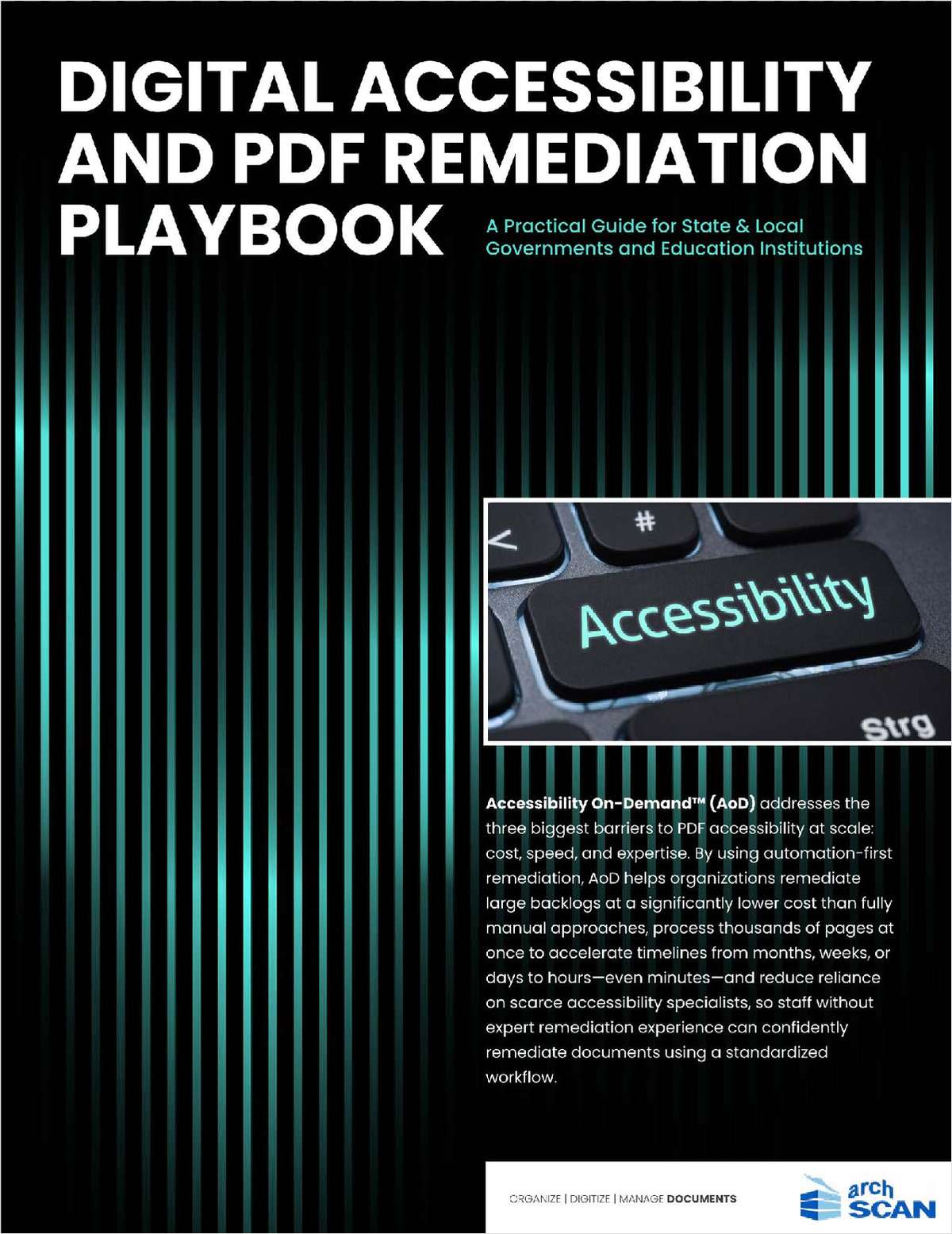

Request Your Free Playbook Now:
"Digital Accessibility and PDF Remediation Playbook: A Practical Guide for State & Local Governments and Education Institutions"
A practical, scalable approach to achieving PDF accessibility compliance. Learn how state and local governments and education institutions can meet WCAG 2.1 Level AA requirements faster, reduce risk, and remediate large document backlogs efficiently using automation-first workflows.
The Digital Accessibility and PDF Remediation Playbook provides a clear, actionable roadmap for public sector organizations and educational institutions facing growing pressure to meet WCAG 2.1 Level AA compliance requirements ahead of upcoming ADA deadlines.
As regulatory enforcement intensifies, organizations are confronting a common challenge: scale. Thousands—often tens of thousands—of PDFs exist across departments, websites, and systems, with limited visibility into what exists, what is compliant, and where the greatest risk lies. Manual remediation alone is too slow, too expensive, and too resource-intensive to meet compliance timelines.
This playbook outlines a modern, automation-first approach to accessibility that enables organizations to move faster while maintaining accuracy and compliance. It introduces strategies to assess readiness, identify and prioritize document backlogs, and implement scalable remediation workflows that balance automation with human quality assurance.
Readers will gain insight into how to:
Quickly audit and inventory existing PDF assets
Prioritize documents based on risk, usage, and compliance requirements
Implement automation to remediate thousands of pages simultaneously
Maintain governance and publishing standards to prevent future accessibility debt
Demonstrate measurable progress and good-faith compliance to reduce legal exposure
The playbook also emphasizes the importance of accessibility beyond compliance. Accessible documents improve usability for individuals with visual impairments, dyslexia, ADHD, and other conditions, ensuring equitable access to critical information and services.
By combining intelligent automation with structured workflows and human validation, organizations can significantly reduce remediation costs, accelerate timelines from months to days—or even hours—and build sustainable processes for ongoing compliance.
Ultimately, this guide equips organizations with the tools, frameworks, and confidence needed to transition from reactive compliance efforts to a proactive, scalable accessibility strategy—one that minimizes risk, supports inclusivity, and ensures readiness for ADA 2026 and beyond.
Offered Free by: archSCAN
See All Resources from: archSCAN
Recommended for Professionals Like You: